Salt loading before the start: a topic that comes up every time a runner or triathlete finishes a long distance with cramp, a heavy head and the feeling that they drank plenty of water yet never felt any better. This article is about how sodium works during prolonged exercise, why hypertonic concentrates such as Hydrazero Sea Water by 226ERS are needed, and how to fit them into a plan for before the start, during the race and after the finish. It will be useful to anyone preparing for a marathon, a multi-hour bike ride or a trail race where aid stations are few and you sweat a great deal.
Hypertonic, isotonic, hypotonic: what is the difference
All sports drinks are compared with blood by the concentration of dissolved substances. A hypotonic drink is more dilute than blood and leaves the stomach faster, which is why it is chosen when the main task is simply to drink. An isotonic drink is close to blood in concentration and delivers fluid, carbohydrate and salts at the same time. A hypertonic drink is more concentrated than blood: it is not a drink to be taken by the litre, but a small portion of minerals that the body dilutes itself. That is exactly why a concentrate is taken in a small volume and washed down with water, rather than used instead of your bottle in training.
How much sodium is lost in sweat per hour
The spread in losses is enormous. Sweat carries away between 0.5 and 2 litres per hour and between 200 and 2000 mg of sodium per litre. In other words, one athlete loses around a hundred milligrams of salt in an hour of long work, while another, larger and a heavy sweater, in the heat and in tight kit, loses several times more. Hence a simple rule: there is no universal electrolyte dose, you work yours out for yourself. Everyone has their own reference points: sweat weight across a session (weighing yourself before and after), salt stains on your cap and shirt, and how you feel in the second half of a long session.
Hydrazero Sea Water: what is inside the 20 ml sachet
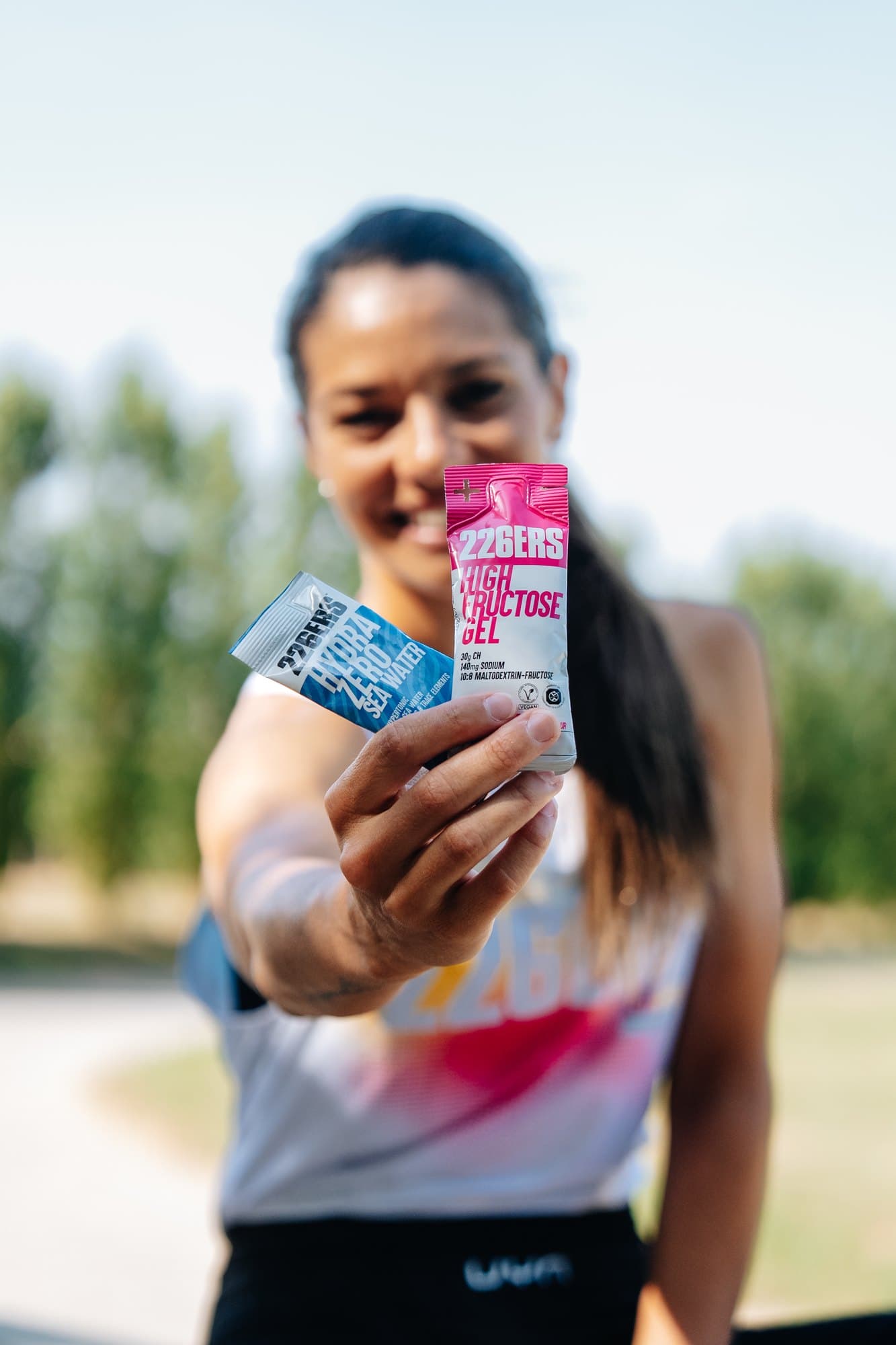
Hydrazero Sea Water is filtered sea water in a 20 ml sachet. It contains 220 mg of sodium, magnesium and more than 80 trace elements, with no additives, no sugar and no calories. That last point matters to anyone counting carbohydrate in a race: the salt from such a sachet does not clash with your planned gels and drinks, and it can be added on top of any carbohydrate plan. It differs fundamentally from the familiar bottled Hydrazero: the bottle is a ready-to-drink product, the sachet is a concentrate.

How to take a hypertonic drink: as a shot or in a bottle
There are two workable options. The first: down the sachet as a shot and immediately wash it down with water, so the minerals reach the stomach in concentrated form and the water follows and dilutes them. The second: pour the sachet into a bottle or flask and drink it in your usual pattern, sip by sip. The first approach suits the time before the start and after the finish, the second suits long work, when you are drinking to a schedule anyway. What you should not do: take the concentrate with no water at all and hope it will quench your thirst. Salt without fluid does not solve hydration, and it can sit heavily in the stomach.
Salt before the start: why build a reserve in advance
If the distance is long and the conditions are hot, starting the race already in deficit is a poor deal. A sachet before the start gives you a reserve of salt that helps the body hold on to the fluid you drink during the first hours of work. The logic is the same as with carbohydrate loading: you are not making up losses after the fact, you are creating a small buffer before sweating begins. In practice it is convenient to tie the dose to the last calm moment before the start pen, when your number is already pinned on and you are taking your final sips of water.
Sodium in the race: a sachet an hour instead of capsules
Over a long distance, a sachet an hour replaces salt capsules. For many people this is easier: there is nothing to remember about how many tablets to take and what to wash them down with, and the concentrate can simply go into your next flask. The main rule of long races stays the same: salt and fluid only work alongside carbohydrate, and only if the plan has been rehearsed in training. Any new fuelling plan is tested during long work at a similar pace and in similar weather, not on race day.

After the finish: water, salt and blood volume
After hard work you want to drink, and most often people drink plain water. But a sachet after the finish restores blood volume faster than water does, because sodium arrives along with the fluid and helps retain it. If you only drink water in large volumes, part of it passes straight through, and the sluggishness and heaviness in the head drag on until the evening. A sensible order of events is this: fluid with salt first, then protein and carbohydrate in your usual recovery meal, then calm attention to your drinking for the rest of the day.
Typical electrolyte mistakes over long distances
The first mistake: drinking only water when sweat losses are high, especially over distances longer than three hours. The second: remembering about salt once the muscles have already cramped, when the plan should have started in the first hour. The third: taking the concentrate without washing it down with water. The fourth: copying another athlete's dose without knowing your own sweat rate. The fifth: trying a new format for the first time on race day. All five are solved the same way: the drinking and salt plan is written out in advance and tested in training.
The sauna, the aeroplane and days without training
The same logic applies outside sport. After the sauna, on a plane and on the morning after a long evening, the body loses fluid and salts, and in those situations people usually drink water alone. A concentrate with sodium makes sense here for exactly the same reason as after the finish: it helps you hold on to what you drink. It is not a substitute for proper food and sleep, but a handy tool for situations in which a fluid deficit appears without any training at all.
A hypertonic drink made from sea water is not a miracle supplement, it is a compact way of delivering sodium to the body at the right moment: before the start, in every hour of long work and straight after the finish. Begin by assessing your own sweat losses, then write salt into the gel and drink plan that already works for you, and rehearse it in training. Hydrazero Sea Water by 226ERS and other electrolytes for runners, cyclists and triathletes are available in the spacefuel.kz range.


FAQ
How does a hypertonic drink differ from an isotonic one?
An isotonic drink is close to blood in the concentration of dissolved substances and is taken by the volume, like an ordinary drink. A hypertonic drink is more concentrated than blood, so it is taken in a small portion and washed down with water, or added to a bottle.
How much sodium is lost in sweat during an hour of training?
Sweat carries away between 0.5 and 2 litres per hour and between 200 and 2000 mg of sodium per litre. The spread is very wide, so electrolyte doses are chosen individually, based on your own sweat rate and how you feel.
When should you take Hydrazero Sea Water over a long distance?
A sachet before the start gives you a reserve of salt, a sachet an hour during long work replaces salt capsules, and a sachet after the finish restores blood volume faster than plain water does. Any plan is worth rehearsing in training before race day.