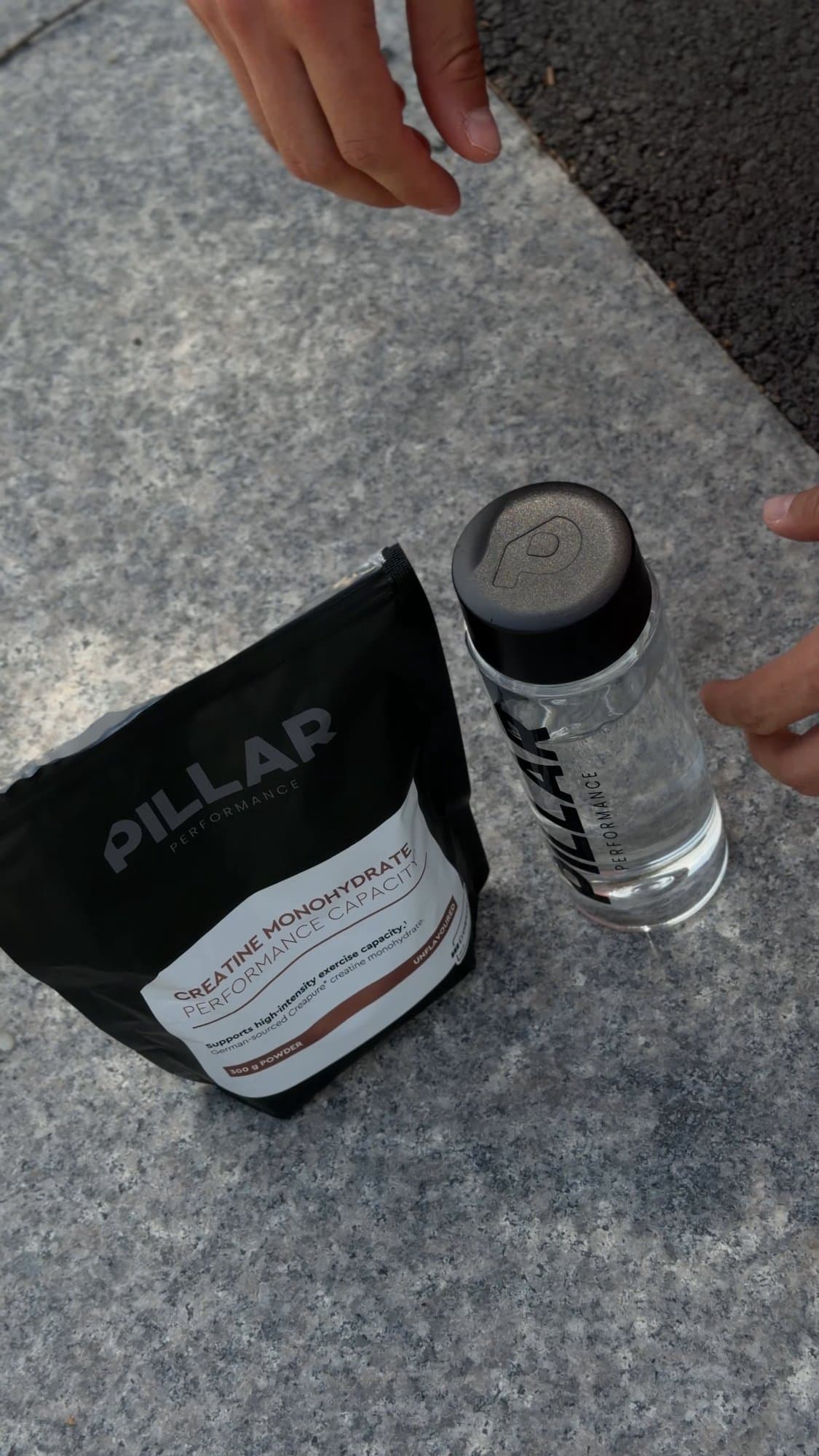
Creatine for runners was long dismissed as a supplement from “the wrong discipline”: it was associated with barbells, gaining mass and strength sports. Meanwhile, the question of why a runner would take creatine has become one of the most frequent among amateur runners, cyclists and triathletes. A PILLAR publication dated 28 August 2026 raised the question directly, and the answer comes down to three practical jobs: finishing accelerations, core strength under accumulated fatigue, and recovery between hard sessions. Let us see how that logic looks from the point of view of the training process, and how to avoid the usual mistakes.
What creatine does in the muscle: a short physiology lesson
Muscle contraction is paid for with the ATP molecule, and the store of it inside a fibre is extremely small: enough for a few seconds of intense work. Creatine in the form of creatine phosphate acts as a fast reserve for regenerating ATP, which means it serves the shortest and most powerful energy system. You run a long distance on aerobic metabolism, but inside any race there are sections paid for by precisely that reserve: the start, a climb, an overtake, a surge over the final metres. This is why creatine does not replace carbohydrate fuelling on the course, it complements it in the places where carbohydrates simply cannot act quickly enough.
Creatine and the finishing acceleration over a long distance
Many races are decided not by average pace but by the ability to add something when the muscles are already tired. A finishing sprint, a break on the final lap, an acceleration on a long drag at the end of the bike leg: all of this is short, powerful work against a background of deep fatigue. This is exactly where a raised intramuscular phosphocreatine reserve brings practical benefit. The same applies to interval training: in series of short efforts with incomplete recovery it is easier for the athlete to hold pace in the last repetitions, which means the session turns out better in quality rather than merely harder.
Core strength and running form under fatigue
The second job named by PILLAR is less obvious but no less important: core strength under fatigue. When the trunk stops holding its position, the pelvis drops, the chest closes, the stride shortens and the load on the foot and knee increases. This is one of the main reasons why the second half of a marathon or a trail race feels disproportionately harder than the first. Strength work, and the ability of the muscles to perform it in a fatigued state, directly determines whether your form survives to the finish. Creatine in this scheme supports the strength component of training, not running itself.
Recovery between hard sessions
The third job: recovery between hard sessions. Any progression in running is built not on one good workout but on the ability to repeat quality work two or three days later. If an athlete comes to the next key session under-recovered after intervals and a long run, volume goes up but results do not. Supporting recovery makes it possible to hold a dense microcycle without a collapse in quality: fewer days when the session is technically completed but without the required speed. This is especially noticeable in triathlon, where three disciplines and strength work compete for the same resource.
Why people choose creatine monohydrate with nothing added
Maksim from the team takes Creatine Monohydrate: a simple formula with no extra ingredients. Monohydrate remains the default choice precisely because it is predictable: one active substance, a clear dose, and none of the accompanying components that, for an endurance athlete, often simply duplicate other products in the diet. For a runner or a cyclist it is also convenient because the supplement slots easily into a fuelling routine that already exists: recovery protein, carbohydrates for sessions, electrolytes. The simpler the formula, the easier it is to understand what is actually working.
Typical mistakes when taking creatine in running
The first mistake: expecting an effect from a single dose before a race. Creatine works through accumulation in the muscle, so only regular intake makes sense, not a “race-day” dose. The second: starting a few days before an important competition and running into unfamiliar sensations, including slight water retention in the first weeks. It is sensible to test any new supplement during a training block rather than on race day. The third: treating creatine as a substitute for work. It supports the strength component and recovery, but it creates neither an aerobic base nor running economy.
How to fit creatine into the training cycle
The most logical place for creatine is the base and strength period, when the plan includes regular strength sessions, gym work and short speed efforts. In that period the supplement supports exactly the kind of work it is suited to. Closer to the competitive period, priority shifts to carbohydrate fuelling on the course and to rehearsing race strategy. Importantly, taking creatine does not cancel the basics: enough carbohydrate, normal sleep and sensible hydration. A supplement strengthens a system that already works, and gives almost nothing to a system short of sleep and calories.
Who should discuss it with a doctor
Creatine is among the most studied sports supplements, but that does not mean it suits everyone in every situation. If you have a chronic condition, take medication on an ongoing basis or are under observation regarding kidney function, the decision is better made together with a doctor. The same is sensible if the athlete is young, pregnant or preparing for competition with anti-doping control: in the last case what matters is the manufacturer's reputation and the presence of quality control, not only the ingredient list on the label.
The conclusion is simple: for an endurance runner, creatine is not about mass but about the three specific things named by PILLAR: being able to accelerate at the finish, keeping core strength under fatigue, and recovering faster between hard sessions. It works only alongside regular intake and a well-structured training process. PILLAR products, including Creatine Monohydrate, are available at the spacefuel.kz store.
FAQ
Why would an endurance runner take creatine if the distance is aerobic?
Inside any race there are short, powerful sections: the start, a climb, an overtake, the finishing acceleration. These are paid for by the phosphocreatine reserve, which is what creatine supports. Beyond that, it helps core strength under fatigue and recovery between hard sessions.
Can I take creatine just once before a race?
No, that is a typical mistake. Creatine works through accumulation in the muscle, so only regular intake makes sense, not a dose taken immediately before the start. It is sensible to test a new supplement during a training block rather than on race day.
Why do people choose creatine monohydrate with no additional components?
Monohydrate is predictable: one active substance and a clear dose. A formula like that is easier to fit into an athlete's existing fuelling routine, which already includes protein, carbohydrates and electrolytes, and it is easier to see what is actually producing the effect.