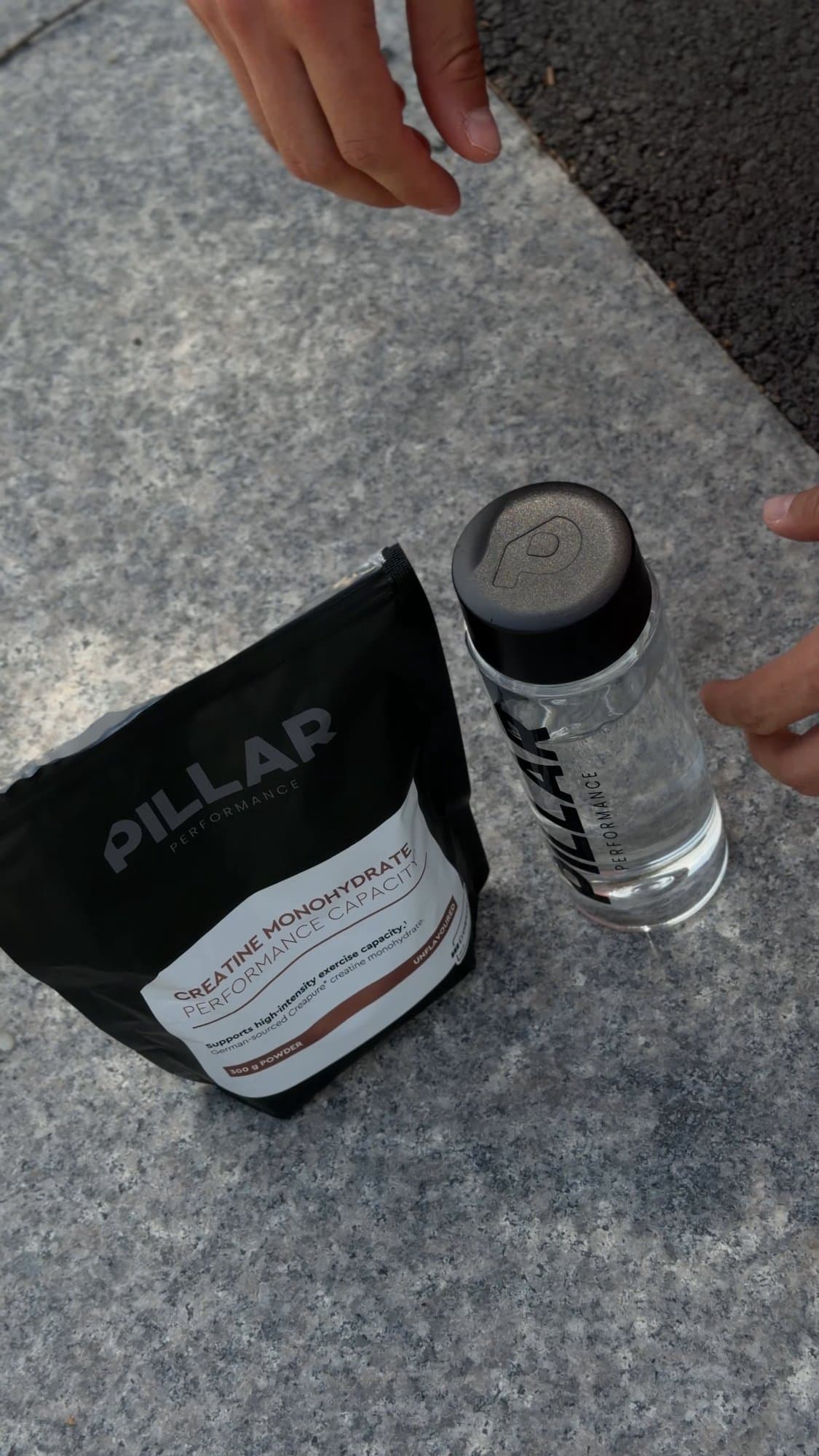
Creatine monohydrate was long seen as a gym-only supplement, yet today it turns up more and more often on the lists of runners, cyclists and triathletes. Creatine Monohydrate from PILLAR Performance follows that same logic: it is one of the most thoroughly studied supplements in sports science, and not only for strength disciplines. Let us look at what creatine really gives an endurance athlete, how to fit it into a training plan and which mistakes most often stop people getting any benefit from it.
How creatine works in the muscles
Creatine is stored in the muscles as phosphocreatine and serves as a fast reserve for regenerating ATP, the main energy molecule behind muscle contraction. When you make a sharp acceleration, come out of the saddle on a climb or launch into a finishing sprint, it is this system that covers the first seconds of work before glycolysis and the aerobic pathways come up to speed. Extra creatine in the diet raises the store of phosphocreatine in the muscle, which means it widens that short but important reserve. It has no direct effect on your marathon aerobic base, but it shows up wherever power is required.
Why endurance athletes need creatine
For endurance athletes creatine works on the fast accelerations at the end of a race and on core strength under fatigue. Few distances are ever even: attacks in a road race, long climbs on a trail, the final kilometre of a 10K, the overtakes coming out of transition in a triathlon. Every one of those moments is paid for out of the anaerobic reserve. The second point is less obvious: when your technique starts to fall apart in the last quarter of a race, what keeps your torso and hips in place is the strength endurance of the stabilisers, not your aerobic form.
Creatine and recovery between hard days
The second reason creatine is interesting for endurance athletes is recovery between hard training days. In a dense block, where intervals sit next to long and strength sessions, the bottleneck is not motivation but how quickly you return to normal. Creatine helps you tolerate repeated high-intensity loads, so the second and third quality sessions of the week come more consistently. It is important to understand the limits: the supplement does not replace sleep, carbohydrates after a session or sensible planning of volume. It only lifts the ceiling of what you are able to absorb a little.
Why people choose plain monohydrate with no additives
There are plenty of creatine forms, but the simple formula remains the baseline choice: creatine monohydrate with no additives, dissolved in water or juice. Monohydrate is the best studied of all the options, and the alternatives have yet to show a convincing advantage despite a higher price. The absence of flavourings, sugars and extra ingredients is practical too: the powder is easy to add to any drink, it does not clash with an isotonic or a recovery shake and it adds no surplus calories to your diet. This is a case where a simple composition is a plus rather than a compromise.
How to take creatine: consistency is what matters
Creatine does not work like a pre-race gel but as a cumulative supplement: the effect appears once the muscles are saturated and lasts as long as you keep taking it regularly. Hence the practical conclusion: daily discipline matters more than the exact timing. Many people attach their serving to a recovery drink after training simply because that makes it easier not to forget. For the way to take it and the amount, check the product packaging, and if you have any doubts because of health conditions or medication, discuss it with a doctor. It is worth washing it down with plenty of fluid, especially in hot weather.
Creatine and weight: what a runner should expect
The main worry endurance athletes have sounds like this: the supplement will add extra kilos. Creatine does hold water inside the muscle cells, and your weight may rise slightly when you start taking it. This is intracellular fluid, not fat and not swelling, and for most kinds of work the gain is insignificant. If you race mountain trails or watch every gram on the climbs, it makes sense to start in the base period and see how your body responds, rather than introducing something new a couple of weeks before a target race. Every supplement gets tested in training.
Common mistakes when taking creatine
The first mistake is “course” thinking: a few days of taking it, then a pause, then another attempt. Saturation is never maintained that way, and the effect has no time to appear. The second mistake is expecting a quick jump in endurance: creatine affects short-duration power and the tolerance of repeated loads, not your aerobic threshold. The third mistake is experimenting during race week, when any new sensation in the body is read as a problem. The fourth and most common one: taking a supplement while under-eating carbohydrates and under-sleeping, where the real problem is solved by your routine, not by a powder.
How to fit creatine into a training season
The most logical time to start is the preparation period, when the plan includes strength work in the gym, short hills and sprints. At that point creatine helps you do better quality work on exactly the sessions that later convert into finishing speed. After that it stays on as a background supplement through blocks with a high density of intensive training. You should separately keep in mind your federation's rules and the status of the product if you compete at events with doping control: creatine is not a prohibited substance, but it is worth choosing products from trusted manufacturers.
The conclusion is simple: creatine monohydrate does not make an athlete more enduring on its own, but it gives you a reserve of power for accelerations, helps you hold your torso together at the end of a race and makes hard training blocks easier to handle. It is an inexpensive and well-studied foundation that makes sense once your nutrition and routine are already in place. Creatine Monohydrate from PILLAR costs 24 850 ₸ and can be found alongside the rest of the endurance nutrition range at spacefuel.kz.
FAQ
Do runners and triathletes need creatine?
It helps those whose races involve accelerations, climbs and a finishing sprint, and whose plans include strength and interval sessions. Creatine has no direct effect on the aerobic threshold, but it does help with short-duration power and the tolerance of repeated loads.
Does creatine cause weight gain?
A small gain when you start taking it is possible, due to water inside the muscle cells rather than fat. For most kinds of work this is insignificant, but it is better to start in the base period rather than right before a target race.
When is the best time to take creatine?
The exact timing matters less than daily consistency, because the effect is cumulative. Many people attach their serving to a recovery drink after training, and check the amount on the product packaging.