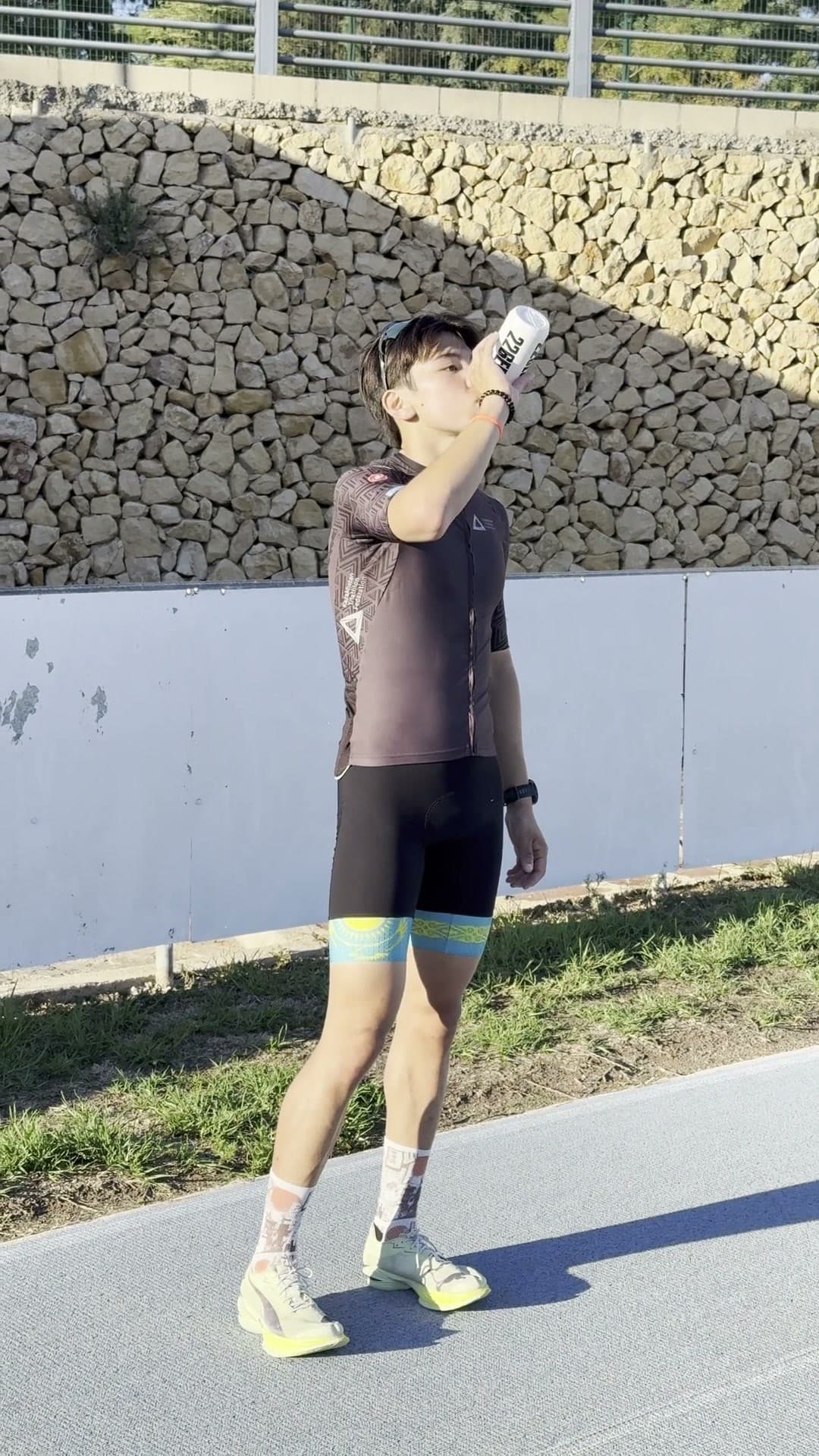
Swim nutrition gets discussed less often than a marathon or bike fuelling plan, yet the pool is where an athlete most often ends up with no fuel at all: there is nowhere to put a bottle, drinking on the move is awkward, and a session easily runs past an hour and a half. This piece is about how triathlete Daryn Konysbayev approaches his swim sessions, and how to apply the same logic to your own training. He raced a season in all three disciplines at once and at the end of October 2026 was preparing for a series of start
Why carbohydrate is not burned any more slowly in the pool
The feeling of lightness in the water is deceptive. The body does not overheat as obviously as it does when running, you cannot feel the sweat, and the load seems moderate. In reality almost the whole body is working, and in terms of energy demand interval sets are closer to threshold running than to an easy cross-country jog. Muscle glycogen stores are limited, and in the second hour of work they drop noticeably whether the athlete is in the water or on the track. Hence a simple rule: if a swim lasts more than an hour and contains intense segments, fuel needs to be planned in advance.
Fructose on an intense swim: why it is needed
Daryn does his hard swim sessions on fructose and his long easy ones on a gel. Behind that split lies an idea well known in sports physiology: different carbohydrates are absorbed through different transport routes in the gut, so a mixture of them lets the body take in more carbohydrate per hour than glucose alone. The fructose component takes on part of the flow and reduces the load on a single channel. The practical bonus for swimming is that a concentrated drink or a single serving is easy to leave on the poolside and take during a break between sets, without breaking up the structure of the session.
One gel per hour of work: how to count carbohydrate
On a long easy swim Daryn has one 226ERS High Energy gel, which contains 50 grams of carbohydrate, and that is enough for an hour of racing. It is a convenient unit of measurement for any endurance athlete: you stop thinking in terms of “eating something” and start counting grams of carbohydrate per hour. After that it is simply a matter of matching the amount to duration and intensity: a short session of up to an hour usually needs no fuel, while two hours of work calls for a regular supply. The higher the intensity, the more important it is to follow a schedule rather than wait for hunger.
How to take a gel before the water and during a session
The logistics in a pool are simpler than they look if you prepare on dry land. The gel is taken before getting into the water, ahead of the main set, and a second one is left at the poolside to be picked up during a planned break. The drinks bottle goes on the starting block or by your feet in your own lane, and you drink in the same rest windows your plan already contains. The main thing is not to invent a new scheme on race day: any nutrition is trialled in training first, so that you learn how your stomach reacts to concentrated carbohydrate in a horizontal position and while breathing to the side.
Three disciplines in one season: the price of versatility
Daryn raced a season across three distances at once, and that is a serious load not only on the musculoskeletal system but also on metabolism. When a week contains swimming, cycling and running, the total volume of work adds up while recovery windows become fewer. Under those conditions a carbohydrate shortfall does not show up immediately: first the quality of the final sets drops, then sleep and mood get worse, and only then does the athlete notice that progress has stalled. That is why for triathletes nutrition in training is not a luxury but a way of reaching the end of the week in working order.
Preparing for a run of races: the Asian Championship, the World Cup
Ahead of him is a series of races: the Asian Championship, the Asian Cup and the World Cup. A block of competitions one after another changes the priorities: the main task is no longer to build form but to carry it to every start without a slump. The general approach to such a period is well known and does not depend on level: volume comes down, intensity is kept with short segments, and between races maximum attention goes to carbohydrate and sleep. By this point race nutrition should be rehearsed well enough that no decisions have to be made out on the course.
Recovery Drink after a session: why you close the window
After training Daryn has a Recovery Drink, in the evening he sleeps, and the kilometres do the rest. A recovery drink solves two tasks at once: it returns carbohydrate to the muscles and supplies protein to repair tissue. The sooner that happens after hard work, the easier the next day goes, especially when there are two sessions in a day. A separate advantage of a drink is that appetite is often missing after a tough set, and getting a serving down is easier than forcing yourself to eat a full meal.
Sleep as part of the recovery protocol
The “in the evening he sleeps” item in this scheme is not a formality. Sleep is when the main processes of adapting to training load take place, and no supplement makes up for a shortage of it. For an athlete who trains late, that means working on the routine itself: finishing a hard session not too close to bedtime, having time to eat, cutting bright light and noise. The most common mistakes here are simple ones: training until midnight, an empty stomach after the work, and trying to make up volume at the expense of hours of sleep.
Typical mistakes in swim nutrition
The first mistake is having no fuel at all on long swim sessions, because “you do not feel like eating in the water”. The second is a new flavour or a new gel format right before an important race. The third is a lopsided approach: either the athlete never counts carbohydrate at all, or counts it only on race day and eats at random through the training weeks. The fourth is ignoring recovery straight after the work, when fatigue builds up over weeks and only gives itself away as a drop in pace.
The underlying scheme is simple: fuel matched to the character of the session, carbohydrate on long work, a recovery drink straight afterwards and proper sleep. The kilometres really do take care of the rest. The 226ERS nutrition Daryn uses is in stock at spacefuel.kz, where his promo code DARYN10 also applies.



FAQ
Do you need nutrition on a swim session?
If a swim lasts more than an hour and includes intense segments, it is worth planning fuel in advance. Short sessions of up to an hour usually go fine without nutrition.
How much carbohydrate is in a 226ERS High Energy gel?
One High Energy gel contains 50 grams of carbohydrate. According to Daryn Konysbayev, that is enough for an hour of racing.
Why use fructose on an intense swim?
Different carbohydrates are absorbed through different transport routes in the gut, so a mixture of them allows more carbohydrate to be taken in per hour. The fructose component reduces the load on a single channel.
Read next